KBR Equestrian Safety Series"CATCHING DIFFICULT HORSES"By Willis Lamm

Revised January 3, 1999 Revised August 2, 2012 |
|
A new horse introduced to an established group will often be driven away by the dominant horse in the group. However, the new horse will keep returning to the group, regardless of how many times it is kicked, bitten, etc. by the dominant horse. Even as the new horse starts to be accepted by the group, it will often suffer physical pain from other horses as part of the acceptance process. It comes as no surprise that a herd bound or barn sour horse is going to be difficult and will try to go back "home". No matter how hard the rider kicks and spurs, he won't inflict the kind of pain that other horses could, and he often won't overcome that social urge for the sour mount to be with his buddies. The rider has to gain some kind of acceptance from the horse in order to proceed. What we can learn from this illustration is that confronting natural conflicts in the horse by force is not the best course of action. Aggressive attempts to drive the horse away from his herd mates can often reinforce the horse's instinctive esistance to leave the group. Aggressive or forceful tactics can often increase the horse's emotional stress to the point that it "blows up" or does something unpredictable and dangerous to the rider which might otherwise be out of character for that particular horse. Consequently, an important element of equestrian safety is to try to understand the horse's instincts and handle the horse in a manner which creates the least amount of emotional conflict. |
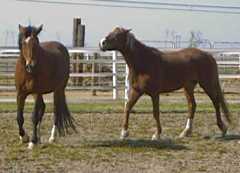 All horse behavior relates to search of pleasure and avoidance
of pain. Most people understand this, however many don't
consider the effect that instinct has on pleasure/pain.
Satisfying nature's instinct is often more satisfying to a horse than physical pleasure. Correspondingly, the stress invoked by frustrating these instincts can often be more of a concern to the horse than physical pain. A simple example illustrates this point.
All horse behavior relates to search of pleasure and avoidance
of pain. Most people understand this, however many don't
consider the effect that instinct has on pleasure/pain.
Satisfying nature's instinct is often more satisfying to a horse than physical pleasure. Correspondingly, the stress invoked by frustrating these instincts can often be more of a concern to the horse than physical pain. A simple example illustrates this point.
| WALLS, DOORS & THE DRAW |
|
When containing a loose horse, it always has to be given a
direction of travel away from people and dangerous situations and
toward containment or an individual who will catch it. The horse has to have a place to go and be able to recognize it. Walls and
pressure without a "door" can result in the horse switching from flight to fight and "taking out" the source of pressure, which is basically charging back at the handler. Most people have a basic understanding of this but many seem to forget it when they become frustrated trying to get a horse to move.
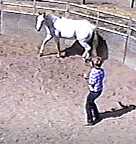
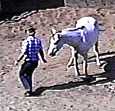
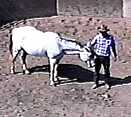
What most people don't understand is the draw. If an excited or unfamiliar horse is going to be caught, it should never be "driven" directly at the person who is planning to handle its head. The horse's instincts are in direct conflict with that objective. If the horse is relatively quiet at the time of the catch attempt, the catcher can set up a "draw" along a fence, etc., whereby he puts slight energy behind the horse's rib cage (just enough to cause the horse to walk or preferably disengage), then step back two or three steps in a relaxed posture. If done correctly, within a few attempts, the horse will instinctively face the catcher. Once the horse has taken this posture, his instinctive factors play altogether differently and the horse is much more likely to accept the catcher's approach. Some horses will actually "hook up" to the catcher so well that the catcher can continue to walk backwards and the horse will come all the way to him. Keeping the situation calm and relaxed improves the odds of this technique working. |
1. The Horse is moving and I back up
|
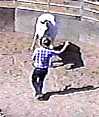
3. The horse continues to follow
|
And eventually catches up
|
| WORKING THE SHOULDER |
|
An excited horse may require some "natural domination" before
being handled. (Please note that in the horse world, domination
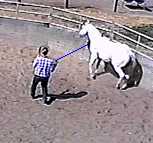
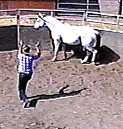
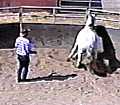
involves establishing leadership and does not have to equate to force or brutality!) An easy and safe way to set this process in motion is along a fence or other solid barrier and applying energy (twirling a rope overhand, using a flag, etc.) in
front of and behind the center of the shoulder.
The purpose of this method is to establish, in natural terms that the horse can quickly grasp, that the handler is the dominant individual in this situation. The intent of the handler's movements is to send the horse forward by applying pressure behind the shoulder, then turning the horse back by applying pressure in front of the shoulder, causing a roll-away. (This should not be done with such force that it sends the horse flying away.) The ultimate objective, once the horse starts to understand that the handler can change the horse's direction, is for the handler to switch from rolling the horse away to changing the horse's direction using the draw. For many reasons it is usually better for the horse to change directions by facing his handler, assuming of course that the horse is not highly agitated and may charge in towards the handler. Once the horse starts turning into the draw, the animal is accepting the situation and a catch may be attempted. When working the shoulder the handler is never directly in front of or directly behind the horse, which is much safer. |
The blue line points to the drive line
|
| NOTES: |
|
These methods, although not difficult, require some timing and
reading of the horse. The first attempts may not be properly
timed, resulting in the horse not responding as desired. Acting aggressively will often stimulate the horse's flight response and compromise the objective of catching the horse. The key element here is to be as quiet and relaxed as possible, and watch
the results of your attempts. Before long the horse can be set
up to be safely caught.
Does this method work? We'll take horses who are taught to be caught (including recently gentled mustangs), turn them out on the ranch to graze, then bring them in when it's time to be put up, with seldom a fuss! For a related information, please see:
(Approaches specifically for wild horses) |
